South Korean Won Climbs Amid Middle East Tensions and Taiwan Dollar Surge
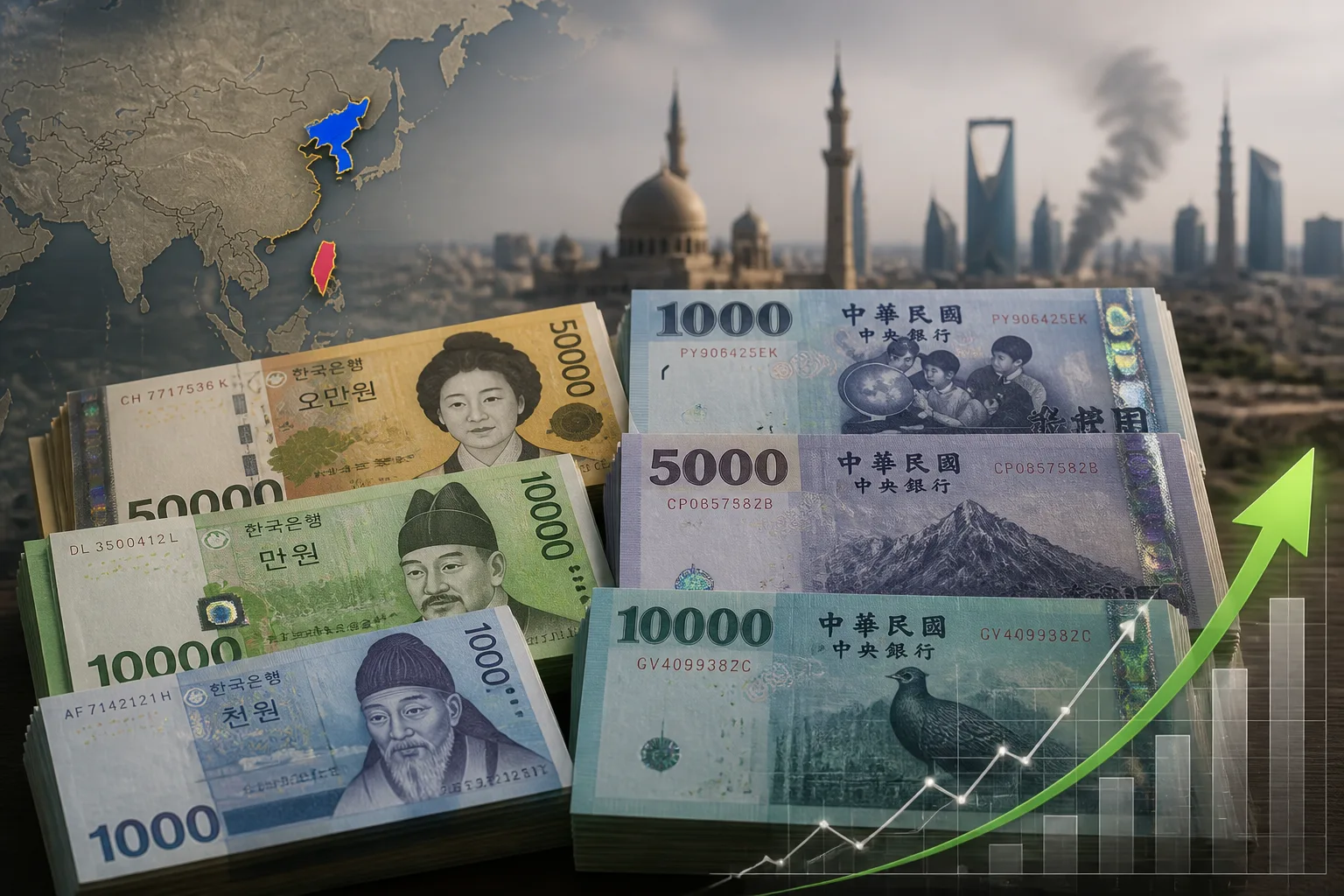
The South Korean won finished Monday’s trading session at 1,538.0 against the U.S. dollar, an 11‑won gain from the previous day. The rate fell to a low of 1,529.7 during the session but recovered in the afternoon to close in the upper 1,530s.
The move reflects a combination of regional currency dynamics and global geopolitical developments. In Seoul, the won weakened as investors sought safe‑haven assets amid heightened uncertainty over U.S.–Iran relations. President Donald Trump’s hardline stance on Iran has amplified fears of renewed conflict in the Middle East, prompting a flight to the dollar.
At the same time, the New Taiwan dollar strengthened, buoyed by Taiwan’s growing role in the artificial‑intelligence (AI) supply chain. Foreign investment has flowed into Taiwanese AI firms, while investment in China has slowed due to the U.S.–China trade conflict and supply‑chain realignment. The divergence between the won and the Taiwan dollar contributed to the won’s downward pressure.
In Tokyo, the dollar‑yen pair rose to the 161‑yen range, signalling a weaker yen. Japanese stocks gained on expectations that a weaker yen would support export earnings, yet dollar buying remained dominant in the FX market.
A foreign‑exchange market official said, "The won came under downward pressure as Middle East risk became intertwined with uncertainty over the U.S. interest rate path." The official added that the won has recovered a significant portion of its intraday decline, but volatility is likely to persist depending on future oil‑price movements and dollar strength.
Oil prices have also played a role. International crude has rebounded, raising inflation concerns and exerting upward pressure on the dollar. The interplay between higher oil prices and a stronger dollar has reinforced the won’s weakness.
During a seminar titled "2026 Second‑Half Exchange Rate Outlook and Industry‑Specific Response Strategies" hosted by the Federation of Korean Industries, chief economist Kim Jin‑wook of Citibank presented a forecast for the won. Kim noted that "expanded AI investment is acting as global growth momentum, and easing Middle East tensions could have a positive effect on international oil prices and financial market stability." He further added that "export growth driven by the semiconductor boom, increased domestic stock investment by local investors, and the potential for a continued current account surplus will act as factors strengthening the won."
Kim projected that the won‑to‑USD rate would remain highly volatile in the upper 1,400s for the near term. Over the next three months, he expected the rate to average around 1,480, easing to roughly 1,450 within six to twelve months.
The forecast aligns with broader market sentiment that the won will remain sensitive to Middle East developments and global commodity prices. The recent escalation in U.S.–Iran tensions, coupled with the U.S. President’s hardline policy, has kept the dollar attractive to risk‑averse investors.
In summary, the South Korean won closed at 1,538.0 on Monday, reflecting a combination of Middle East geopolitical uncertainty, a stronger Taiwan dollar, a weaker yen, and rising oil prices. Market observers anticipate continued volatility in the won‑to‑USD rate, with a gradual strengthening forecast over the next year as AI investment and semiconductor exports support South Korea’s economic fundamentals.
The current situation underscores the interconnectedness of regional politics, commodity markets, and currency movements in the Asia‑Pacific region.