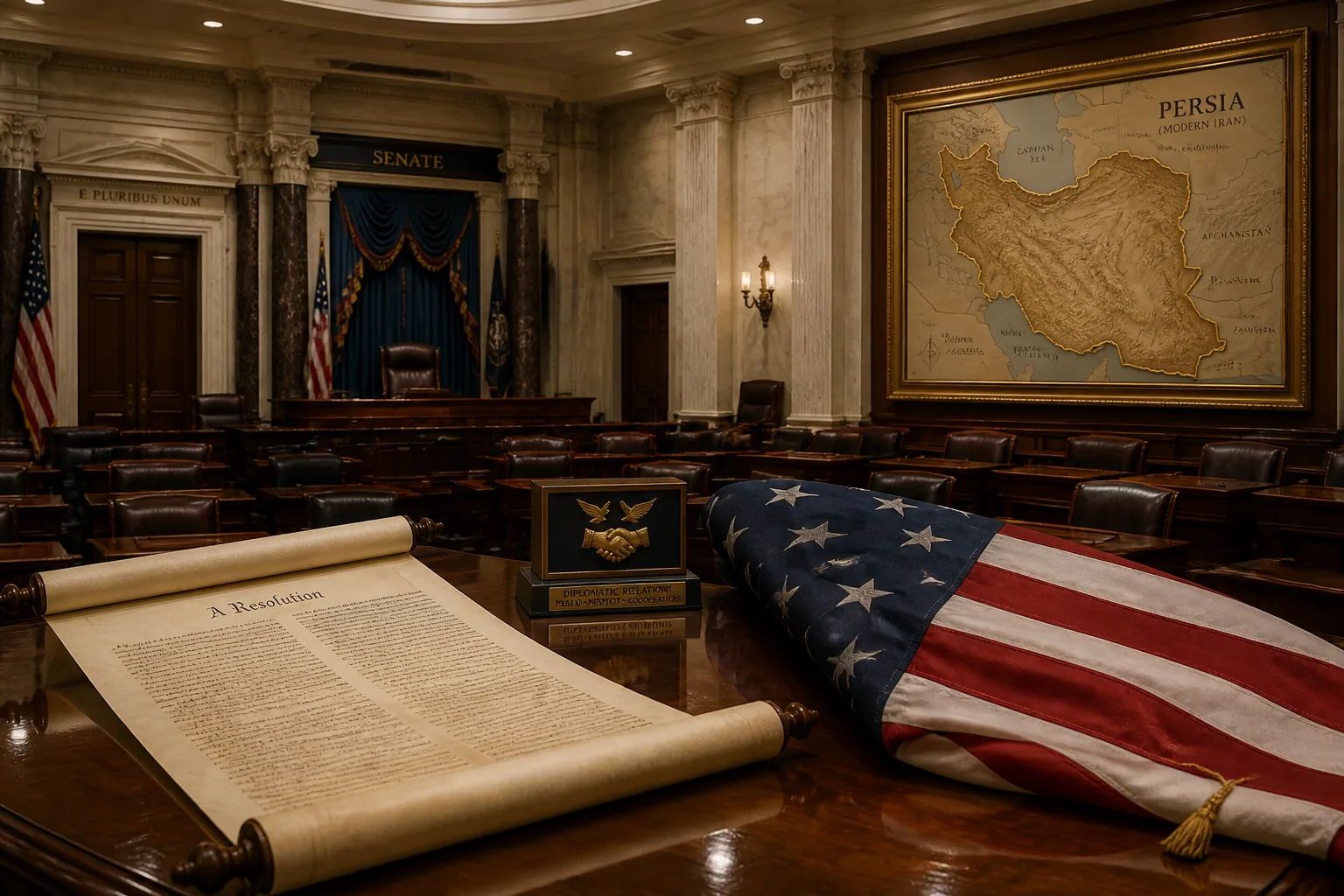
Senate Passes Resolution to End U.S. Hostilities in Iran, 50-48
On Tuesday, June 23 2026, the United States Senate delivered a historic message to President Donald Trump: the war in the Middle East is over, and it is time to end it. In a 50‑48 vote, the chamber adopted a concurrent resolution that directs the president to terminate U.S. military hostilities against Iran. The narrow margin and the fact that four Republican senators crossed party lines make the decision a milestone in American civil‑military relations.
The vote split neatly along partisan lines, but the four Republican senators who joined the Democrats—Rand Paul (Kentucky), Susan Collins (Maine), Lisa Murkowski (Alaska) and Bill Cassidy (Louisiana)—broke the party’s typical stance on foreign military action. Two Republicans were absent: Mitch McConnell (Kentucky) and Dave McCormick (Pennsylvania), the latter attending a Trump rally in his home state. The resolution passed without a presidential signature, a consequence of its status as a concurrent resolution, which means it does not trigger a veto and does not require the president’s approval.
The measure comes on the heels of a three‑month conflict that erupted on February 28 2026 when the United States and Israel launched a joint strike against Iranian military targets. Hostilities ceased on June 14 2026 when U.S. and Iranian officials signed a memorandum of understanding in France, mediated by Pakistan and Qatar. The agreement lifted the U.S. naval blockade of the Strait of Hormuz, released frozen Iranian assets, and set a 60‑day window for further negotiations on Iran’s nuclear program and sanctions relief.
The resolution’s language is straightforward: the president must withdraw U.S. armed forces from hostilities against Iran, except for those necessary to defend the United States or an ally from imminent attack. Because it is a concurrent resolution, the president’s signature is unnecessary, but the text also acknowledges that a presidential veto could still be applied. The White House has repeatedly dismissed the 1973 War Powers Resolution as unconstitutional, arguing that the issue is a political question beyond judicial review.
Congressional action on the war did not begin in the Senate. On June 3, 2026, the House of Representatives passed a similar resolution 215‑208, with four Republicans voting in favor and six members abstaining. The House and Senate now hold the same directive, but the resolution remains subject to a presidential veto.
The passage of the resolution is largely symbolic because the conflict has already ended. Nonetheless, the wording could become operative if hostilities were to resume, and it signals congressional intent to assert oversight over the president’s use of force in a region where U.S. military presence has long been a flashpoint.
The war’s conclusion has had immediate, tangible effects on regional shipping. The Strait of Hormuz—a critical chokepoint for global oil traffic—was reopened following the memorandum of understanding. Gulf Arab states welcomed the de‑escalation, and the United States has pledged to maintain a presence in the region to deter future conflicts.
What follows remains uncertain. If President Trump signs the memorandum of understanding, the resolution may become moot. If he vetoes it, a two‑thirds majority in both chambers could override the veto, but the political cost could be significant.
In the broader context of U.S. foreign policy, the resolution reflects growing congressional scrutiny of executive military action. The War Powers Resolution of 1973 has rarely been invoked, and this new measure may set a precedent for future conflicts in the Middle East.
The resolution’s passage underscores the ongoing debate over the balance of power between the legislative and executive branches in matters of war and peace. For now, the United States and Iran remain in a cease‑fire arrangement, and the resolution stands as a reminder of Congress’s willingness to intervene in the conduct of foreign military operations.