Israeli Settlers Injure Elderly Palestinian Man and Damage Farmland in Surif, Hebron Governorate
On July 19, 2026, a confrontation in the Palestinian town of Surif, northwest of Hebron, left an elderly man wounded and local crops in tatters. Israeli settlers reportedly entered the Khallat Ghneimat neighbourhood armed with clubs, assaulted residents, and threatened the community, according to Surif’s mayor, Hazem Ghneimat.
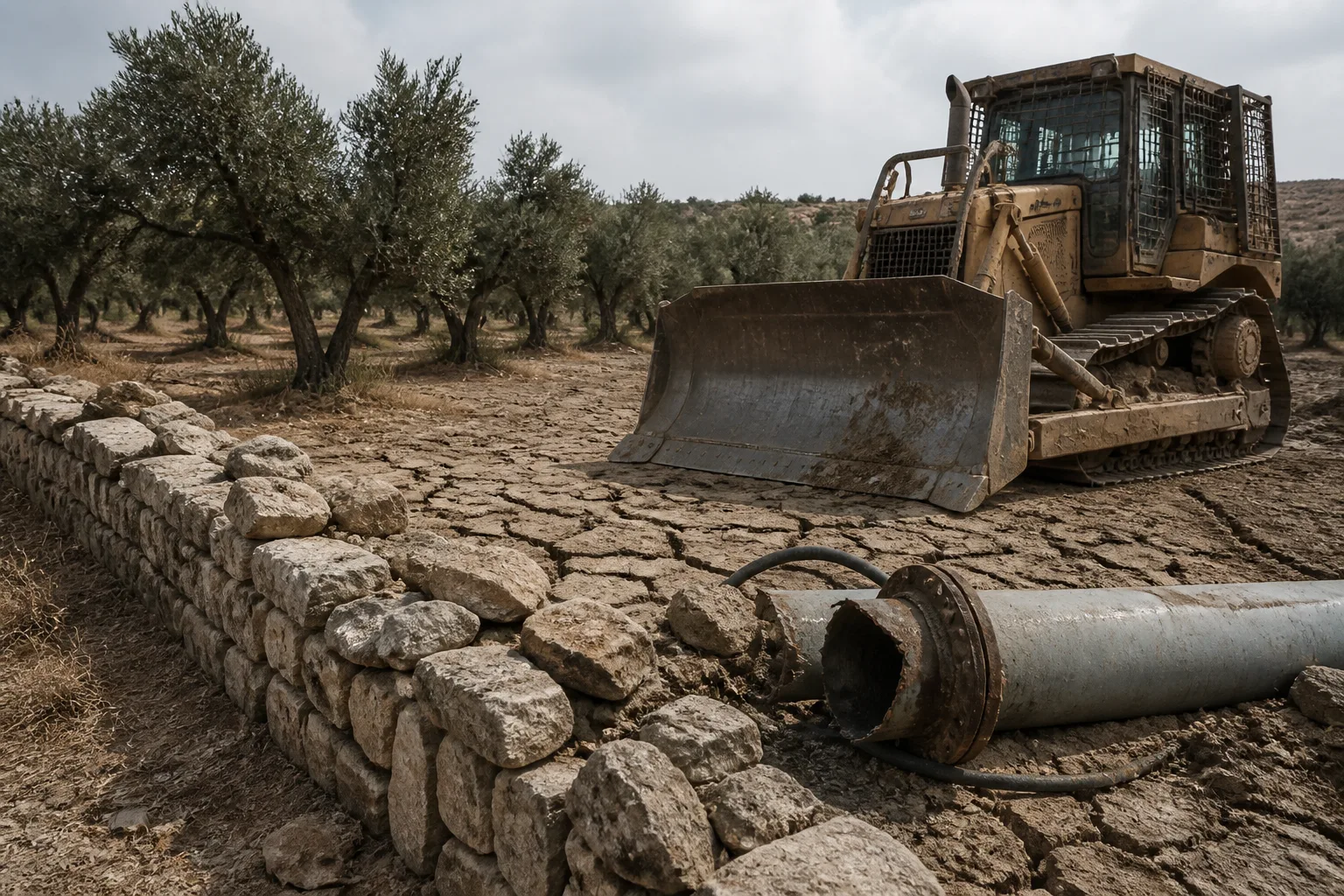
Mayor Ghneimat said the attackers physically struck an elderly Palestinian man and used intimidation tactics against the town’s residents. He also reported a separate incident in which settlers drove cattle onto farmland in the Khallat al‑Homs area, south of Yatta. The livestock trampled fruit trees and crops belonging to farmer Samir Obeid, inflicting direct economic damage.
Surif, a town in the Hebron Governorate, lies roughly 25 kilometres northwest of the city of Hebron. The 2017 Palestinian Central Bureau of Statistics census recorded 17,287 residents, all of whom are Muslim. Agriculture—particularly olives, wheat, and barley—constitutes the town’s economic backbone.
The Hebron Governorate is the largest administrative district in the West Bank, covering 1,060 square kilometres and housing over one million people. Its capital is the city of Hebron, and the current governor is Khaled Dudin.
Israeli settlements in the West Bank occupy land seized during the 1967 Six‑Day War. The United Nations and much of the international community consider these settlements illegal under international law, a stance Israel disputes. Settlements are typically protected by Israeli military forces, and their expansion has been linked to rising tensions and violence against Palestinian residents.
The Wafa report notes a surge in settler attacks on Palestinians and their property within the Hebron Governorate, especially in communities near Israeli settlements and outposts. Ghneimat’s account mirrors a broader pattern of settler aggression observed in other West Bank towns, such as Sa’ir, Idhna, and Masafer Yatta.
In the wider context of the Israeli‑Palestinian conflict, incidents like the Surif assault illustrate the everyday security challenges Palestinian civilians face in the West Bank. The damage to Obeid’s fruit trees and crops represents a tangible economic loss, while the physical assault on the elderly man underscores the human cost of settlement‑related violence.
The Palestinian Authority has repeatedly condemned settler violence and called for stronger protection of Palestinian communities. International observers, including the United Nations Office for the Coordination of Humanitarian Affairs, have urged Israel to prevent such attacks and to investigate the perpetrators.
No statement from the Israeli government or an investigation into the Surif incident has been reported. The Palestinian side has not announced any immediate legal action, though the mayor’s public condemnation indicates that local authorities are documenting the events for potential future proceedings.
The incident underscores the ongoing friction between Israeli settlers and Palestinian residents in the West Bank. While the Israeli military may provide security in some areas, the presence of unregulated outposts and the use of force by settlers continue to provoke clashes and property damage.
At present, tensions in Surif remain high. Local authorities are monitoring the area, and Palestinian residents are likely to seek further protection and compensation for the damage suffered. The international community continues to monitor settlement activity and settler violence as part of its broader engagement with the Israeli‑Palestinian conflict.
In summary, Israeli settlers in Surif assaulted an elderly Palestinian man and damaged farmland belonging to a local farmer. The mayor’s report highlights a pattern of increased settler aggression in the Hebron Governorate. The incident reflects the broader challenges of security, property rights, and human rights in the occupied West Bank, with no immediate resolution announced.